COVID-19: “The Global Crisis that United the World”

We are all in this together.

During times when people were deeply divided on almost every issue, and every debate was being stretched to silly extremes and dangerous arguments, resulting in rampant polarization, not just in this country, but almost as a worldwide trend, I have often wondered, if only everyone in the world could take a pause, and relook at life, in a fundamental way.

Little did I know or imagine, even as recently as a couple of months back, that it would take an invisible microscopic virus, to stop the world in its tracks, and cause an existential rethink.

Today, as the world fights the global pandemic COVID-19, everyone is compelled to slow down, and take the time to reexamine their perspectives and priorities in life. It has given the time for people to reassess and reset their goals, and the opportunity to realize that there is so much more that unites us, than divides us, as human beings.

I hope this unprecedented crisis ends soon, and reboots the world in such a way as to usher in a brand new era of deeper realization, maturity, thought synergy, empathy and understanding, unparalleled cooperation, and everlasting peace and harmony, for the whole world. I hope that posterity sees COVID-19 as “The Global Crisis that United the World.”

Capitalism with a heart

Over the past few decades, it has been a globally well established fact that free market capitalism and globalization have given the world many benefits in terms of driving innovation and entrepreneurship, bringing new products and services to the market, fostering global competition, lifting millions of people from poverty and into the middle class, and generating wealth all around.

Yet, possibly as an unintended consequence and side-effect, we are undeniably seeing unprecedented levels of income and wealth inequality and also a growing trend of protectionism and nationalism worldwide, with many now, even questioning if free market capitalism can ever bridge the gap caused by rising inequality. What is more telling, is that this view is not just coming from the socialists or the so-called left, but even from those that have touted capitalism for long and have benefited from it.


I recently came across the views of three eminent people who have addressed this issue and I briefly list them below:

  1. Philip Kotler the renowned marketing and management guru wrote a book “Confronting Capitalism” in which he lists 14 shortcomings of capitalism as he sees them, and suggests several remedial strategies. He believes that “capitalism is better than any other system”, but advocates that we fix its shortcomings, to balance things up. I read this book and found it to be insightful to say the least. ( http://www.confrontingcapitalism.com )
  2. Raghuram Rajan, the Economics Professor at University of Chicago, former Chief Economist of IMF, and former Governor of the Reserve Bank of India, has recently published a book called “The Third Pillar – How Markets and the State Leave the Community Behind” in which he essentially says that capitalism may have done great things for the Markets and the State, but may have left out the third pillar the Community. From the sleeve notes on the book – “As markets scale up, the state scales up with it, concentrating economic and political power in flourishing central hubs and leaving the periphery to decompose, figuratively and even literally. Instead, Rajan offers a way to rethink the relationship between the market and civil society and argues for a return to strengthening and empowering local communities as an antidote to growing despair and unrest.” (https://www.penguinrandomhouse.com/books/566369/the-third-pillar-by-raghuram-rajan/9780525558316/ )
  3. Ray Dalio, the Founder and Chairman of Bridgewater Associates, one of the largest hedge funds in the world, and a man whose net worth is $16 Billion, wrote a two-part article recently titled “Why and How Capitalism Needs to be Reformed.” He too believes that “capitalism is a fundamentally sound system that is now not working well for the majority of people, so it must be reformed to provide many more equal opportunities and to be more productive.” I read this article and would suggest that those interested in this topic definitely read up his views. (https://economicprinciples.org/Why-and-How-Capitalism-Needs-To-Be-Reformed/?utm_medium=adwords&utm_source=GS&utm_content=341819909261&utm_campaign=60minutes-search

Whether one agrees with them or not, these three luminaries do make us pause and ponder over the issue. I guess there may be many more who concur with them in principle, even though they may differ on the details. To be clear, they are not advocating that capitalism be abandoned. They have just highlighted the flip side of it, and have voiced their educated opinions on how it may be addressed and reformed.

Perhaps just as everything in life is cyclical, a prolonged trend might invariably give rise to a diametrically opposite trend over time.  Perhaps it is time to not dwell only on one-sided views of capitalism, but to consider a balanced approach to chalk out a good path forward that consistently produces equitable growth to more people across the world. Perhaps it is time for capitalism with a heart.


Music, Religion, and Identity

Music can make us feel so many emotions, move us to tears of sadness and joy, stir us to dance and rejoice, cause us to pray and meditate, and give us peace and happiness.

It is said that music is the universal language of mankind. It is the same set of twelve musical notes and octaves that are available for everyone in the world, regardless of their race, religion, gender or nationality. And these notes have given us diverse systems and genres of beautiful music that touch and inspire people in so many different ways.

Yet, one wonders how one ethnic group’s music sounds so sweet to them, but sounds like cacophony to some others! People often say, “I can occasionally appreciate Rock and Heavy Metal but my music is Country, or the Blues, or Classical.” What is it about different genres of music that makes people identify themselves so much with one, but not with the other?

In the west, many musical genres convey myriad themes like love, heartbreak, and even sex, drugs and rock and roll.  In India, popular songs and soundtracks in movies, cover many common emotions but they are a totally different world, when compared to the traditional Carnatic music art form that has lived for hundreds, or perhaps even thousands of years.

Carnatic music (South Indian Classical music), has been synonymous with prayer and worship, with Bhakti (Devotion) as its central theme. Almost all compositions are about Hindu Gods, with lyrics using mythological tales, devotion and philosophy to form some of the main themes. Even some lullabies may be about Rama or Krishna, and the lighter form called ‘Jaavalis’ are typically about Krishna’s romance. Most South Indian music fans perceive Carnatic Music as something very sacred. To them, it is inextricably coupled with prayer and worship and any deviation from this purpose, is deemed to be sacrilegious, by many.

This musical idiom is so deeply intertwined with religion, that using this genre to compose and sing about any other religion, feels so alien to the native style, and stirs up strong emotions and mixed feelings for many, as we have seen in the recent controversy that roiled some classical musicians, fans, and commentators in India.

One of the key contentions is that the classical singer Nithyashree apparently sang a song for an album on Jesus, whose lyrics were allegedly plagiarized from saint composer Thyagaraja’s lyrics, and replacing Rama’s name with Jesus.

Eminent musician Ravikiran has looked into this and denied this claim and has also fully supported Nithyashree. In some songs, some words traditionally used to describe Hindu Gods, may have been used to describe Jesus, and there ends the matter for some, but that is where the controversy begins for many others.

While some artistes and fans may see this as nothing more than an innovative way to use Carnatic music to sing about Jesus, and perhaps foster communal harmony, some opponents to this, see it as yet another blatant attempt sponsored by the Church to usurp Indian culture and distort its indigenous and sacred art forms to preach and convert Hindus to Christianity.

Hinduism has survived many onslaughts, and one could argue that a mere song or album could not convert people to another religion, and dismiss it as nothing more than rabble rousing by the opponents, but the real issue is far deeper for its opponents.

In India, there are several news reports alleging that the Christian missionaries in India have become aggressive in their conversion campaigns in neighborhoods, public places, outside schools, and even outside temples in holy cities. There are reports that many churches actively condemn Hinduism in their sermons and encourage more conversions. Many Hindus see this as an annoying practice and are incensed by what they see as constant attempts by the Church, to discredit and insult their religion and also to convert Hindus into their fold.

Also, recently there have been attempts to take the classical tunes of sacred hymns and Vedic intonations in Hinduism and replace the lyrics with those praising Jesus! This would be akin to how some Christians may feel, if for example, some Hindus took the tunes of a hymn like “Ave Maria” or the popular Christmas Carols, and use the same tunes to sing in praise of Hindu Gods!

Not only does it sound absurd, it also raises questions in the minds of the opponents, on the intent of the evangelicals in India, in trying to usurp these traditional art forms.

Just as in Christianity, some people may not be able to imagine or accept, using the Gospel style of choir singing to praise another God from another religion, many in India cannot imagine or accept using Carnatic music to sing praise of other religions or prophets. While it is perhaps technically possible, purely from a musical point of view, it may feel quite unnatural and unwarranted.

If you mix religious sentiments and politics, the issue cascades with accusations, insults and retorts and deteriorates into an unproductive war of words. Fanatics from all sides take over and not only distort the issue but also add fuel to the fire with their abusive and even intimidating comments.

Therefore, in the wake of the Indian Church’s persistent efforts to proselytize, some Hindus are currently not in any mood to look the other way, and are clearly making efforts to define the boundaries of what is acceptable to them, and what is not, and they may be well within their rights to do so.

Having said all that, nobody should be intimidated for expressing themselves through their art. In the same breath, the creative folks should also perhaps consider how various people may perceive sensitive things, and use their discretion and better judgment in deciding whether something may be appropriate or inflammatory.

One hopes that freedom of expression and creativity are always used responsibly, and that music always remains the magical force that touches people’s souls and brings them together.

Speak up, Moderates!

Polarization is rampant everywhere, on every single issue. Media amplifies it and social media regurgitates it endlessly. Freedom of speech is good, and passion is great indeed, as long as the discussions and debates are civil, positive and constructive.

moderation

The people who are taking the extreme positions are so noisy and vitriolic on all the sides, that trying to talk sense and bring about balance, feels like a Herculean task.

There are perhaps more moderates in this world, than those that take extreme positions, but their problem is that they are silent, perhaps not wanting to risk getting hurt and bloodied, in this senseless war of diatribes and invite a deluge of unsolicited hate mail and despicable comments.

Moderation is certainly the need of the hour, and we need more empathy and understanding on all sides. To some extent, compromise is needed to facilitate people to come to the center and carve out a path ahead, together. Yet, it is often portrayed as surrender, or a sellout, by those who are firmly entrenched in their extreme positions, thereby hampering progress. And if we allow politicians on all sides to fan hatred, instead of fostering mutual understanding, respect and peace, the problem is immensely exacerbated.

Unfortunately, the first casualty in any argument seems to be facts. People have a strong sense of identity that stems from their language, religion, gender, education and upbringing, and they perceive things differently, form their own opinions without verifying facts, and cherry pick only those ‘facts’ or some ‘dimensions of facts’, to corroborate their opinions, and indulge in selective praise or outrage, depending upon their position on any issue.

How can we change this sad and destructive trend? It is possible only if more moderates come forward to break their silence and speak up firmly, and reason with facts and figures, with an abundance of patience and perseverance, and bring people together.

It is perhaps easier said than done, but it is much-needed today, for civility and sanity to return to public discourse and debate.

“Somebody else’s babies” Rep. Steve King? Seriously?

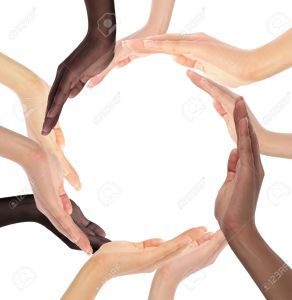
Last July, Representative Steve King (Iowa, Republican) had questioned “other sub groups” and their “contribution to civilization.” I had shared my thoughts in my blog post on it, earlier. Obviously he seems to be on the path of discovering new lows for himself, with his distasteful declaration in a recent tweet – “We can’t restore our civilization with somebody else’s babies.”

When the media asked him to clarify, he reiterated his stance and added, “If you go down the road a few generations, or maybe centuries, with the inter-marriage, I’d like to see an America that is just so homogenous that we look a lot the same,” he said.


16473652-Conceptual-symbol-of-multiracial-human-hands-making-a-circle-on-white-background-with-a-copy-space-i-Stock-Photo

“Homogeneous”? Seriously, Rep. King?

I know that facts may not mean much to you, as we now live in this Trumpian, post-facts era. Nevertheless, let me try to present just three, with the vain hope of educating folks such as yourself.

According to some studies out there:

To me, it is quite obvious that the dire need right now, is to protect and restore civilization from your hateful ideology. And I therefore propose that if you have the ability to do so, please realize your responsibilities as an US Congressman. Please strive to foster and celebrate unity in diversity. Please ensure a civil and harmonious discourse in society, and nurture egalitarian ideals. Please try to bring people together and encourage them to leverage each others’ strengths and complement each other, to make this world a better place.

If you cannot do that, please step aside. Perhaps “somebody else’s babies” should try.


Love and Optimism

I think that life will always be better, if we care enough to preserve and nurture moderation and balance in all things, and in that light, I just felt like writing this sincere verse:

There may be racists in America,

But America is not racist.

There may be Terrorism from Religion,

But Religion is not Terrorism.

There may be the unscrupulous Rich,

But all the Rich are not unscrupulous.

There may be crime amidst the Poor,

But all the Poor are not criminals.

There may be bad folks, in every race, 

But the race in its entirety, is not bad.

There may be stereotypes in general,

But in general, let us not stereotype.

There may be terrible things in Life,

But Life in itself, is not terrible. 

Let us learn to see the whole,

And not just blindly pigeonhole.

The world is full of hatred and pessimism,

Let us together build love and optimism.

Open Letter to Rep Steve King (R-Iowa)

Rep. Steve King (R – Iowa), recently questioned “other sub groups” and “their contribution to civilization.” I think it was a deplorable thing to do, and it needs to be condemned by one and all. This is an Open Letter to him, sharing a few things with the hope that he will change his views for the better, and be more responsible:

Representative Steve King,

People come to this great land, with hopes and dreams that their ideas will be respected, their hard work rewarded, they will have a better standard of living, and that the law of the land will work for everyone, regardless of their gender, race, religion, wealth, and ethnicity.

For you to so callously look down upon “other sub groups” and question “their contribution to civilization” not only reveals your condescension, but also your own ignorance, which is all the more appalling, given your position as a Representative in the US Congress!!

I wish to take this opportunity to highlight what has made America great so far, and what it risks losing now, if folks like you continue your dark and divisive rhetoric. I hope that you will change your views.

Aside from the undeniable fact that America has pioneered so many discoveries and inventions that have totally changed the world, America is great because of its commitment to capitalism and free markets, its ability to absorb great ideas, wherever and whomever they come from, and enable an environment that offers much better chances for success, than most other places on earth. There is absolutely no question about that, even if we take other developed nations into comparison.

Instead of taking justifiable pride in the many great virtues of America, you chose to be very insensitive and irresponsible by looking down upon “other sub groups”.

It is an established fact indeed, that every nation has contributed so much to human civilization, if we only care to notice and learn from each other. Personally, I am an American Citizen now, who migrated from India, and therefore, let me highlight India’s contributions, to name just a few.

And please note that India achieved some of these, long before Christ, Europe, USA, or the Western Civilization (as we know it now), even existed!!

Starting with Agriculture, India had the most advanced Irrigation systems and canals in the Indus Valley Civilization in 3000 BCE. Cotton, Wool, Jute, Sugar, and a great variety of spices, have fostered trade, 1000s of years back. India is a nation where people, not just place a great emphasis on Education but also worship ‘learning’ of all forms, and she is a rich treasure trove of timeless wisdom that has fascinated westerners for several millennia. With 28 officially recognized Languages, and 100s of dialects, India’s  mind-boggling diversity offers a massive body of Literature that the world has always referred to for centuries. In Math, Science and Technology, India gave the world, the concept of Zero, and the numerals that are in use, and several fundamental theories that have formed the basis for subsequent discoveries and inventions. In Medicine, Sushruta was one of the first to advocate the dissection of a human corpse to understand the organs and the functioning of the human body back around 600 BCE, and is considered to be the father of surgery.  India’s Ayurveda and Siddha systems of medicine are in practice for over 3,000 years. In Space Research, India recently succeeded in their first ever Mission to Mars, with a budget less than that of the Hollywood movie ‘Gravity’. With 1000s of magnificent temples, forts and palaces, India’s contribution to Architecture and Engineering, makes her a preferred destination for students of the subject worldwide. India has such a rich repertoire of Arts and Music that it is impossible to summarize here.

As for Religion: Hinduism is being practiced by over 1 Billion people. In its 5, 000 years of known history, it has never made organized attempts to convert others to Hinduism; Never invaded other lands, looted their people, and declared it as ‘common wealth’;  A very healthy tradition of Atheism has always existed within its fold; No fear of blasphemy laws, or religious edicts there. India is also home to Buddhism (which started from there and spread to the East), Sikhism, Jainisim and several other religions, and there is a very rich tradition of religious tolerance and acceptance.

And last but not the least, India gave the world, Yoga and the Kama Sutra around 3rd and 4th Century BCE. 

The above is only indicative, and not exhaustive, but I think I have made my point. Please Google for more information and educate yourself with the several articles, research reports, and documentaries that are abundantly available online.

We live in an interconnected and increasingly interdependent world today, thanks to the power, speed, and reach of technology. At no point in time in human history, have we had the tremendous opportunity as we do now, to get to know each other better and work together for mankind’s progress, and actually earn the right to being called a peaceful, united, human civilization.

Please do not drag us back into the dark ages with your woefully inadequate worldview. America is a land of immigrants who come here with their own cultures and customs, and yet embrace a set of cherished values to ‘become American’ over time. It is at the very heart of what America’s greatness is all about, and she cannot afford to lose that, because of some ill-informed and conceited attitudes.

I know that millions of Americans do not subscribe to your parochial views. I request you not to sow seeds of discord and hatred amongst the people of this great nation, who love to work together in peace, towards progress and prosperity.

And as long as the citizens of this great nation, whose hearts I find, are almost always in the right place, reject such snobbishness, I am confident that America will continue to be a force for good, and a responsible leader that inspires the whole world.

Regards,

Sayee Challapally